
By Winnie Humuhuza, RECE; M.Ed
Every day may seem the same for many people, but for an early childhood educator, each morning feels different. Children arrive holding tightly to their caregivers—some excited, some running in for hugs, some uncertain, and others still waking up to the day. As an Early Childhood Educator, I have learned that what unfolds next is not just “play.” It is learning in its most natural and powerful form.
Play is often misunderstood as something light or optional. I grew up in a place where we played anywhere, everywhere, with everything, and anything. Watching children now reminds me that in early childhood, playing is the work of the child. It is how children explore their world, express emotions, build relationships, and develop essential life skills. Each day in the classroom offers a new reminder of this truth.
One morning, a child who usually rushed into the room stopped at the door and clung to his mother. His body language had changed. He avoided eye contact and held onto her longer than usual. When she left, he didn’t run to the toys. Instead, he quietly came to sit beside me. No words—just presence.
Through play, I gently invited him in. I placed a few toy cars nearby and slowly rolled one across the floor. He watched. After a few moments, he picked one up. There were no instructions and no pressure—just a safe, calm space. That small act of play became his way back into the classroom. Later, I learned he had spent time away from his mother. That day, he wasn’t just playing—he was processing separation, reconnecting, and finding safety again.
This is the hidden language of play.
In another moment, two children argued over a doll. Voices rose and tears followed. Instead of stepping in immediately to solve the problem, I observed. One child held the doll tightly, while the other stood in frustration. Through guided interaction, I asked, “What can we do so both of you feel happy?”
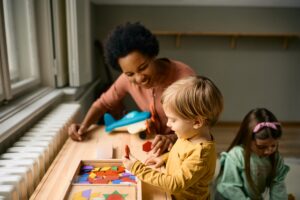
After a short silence, one child suggested, “She can be the mommy, and I can be the sister.” Just like that, conflict turned into cooperation. Play became a tool for problem-solving, empathy, and communication.
These daily experiences reflect what we, as educators, know deeply: play is not separate from learning—it is learning.
In Ontario, How Does Learning Happen? It reminds us that children learn best through exploration, play, and inquiry. These ideas come alive in everyday moments—on the carpet, at the sensory table, or in dramatic play areas.
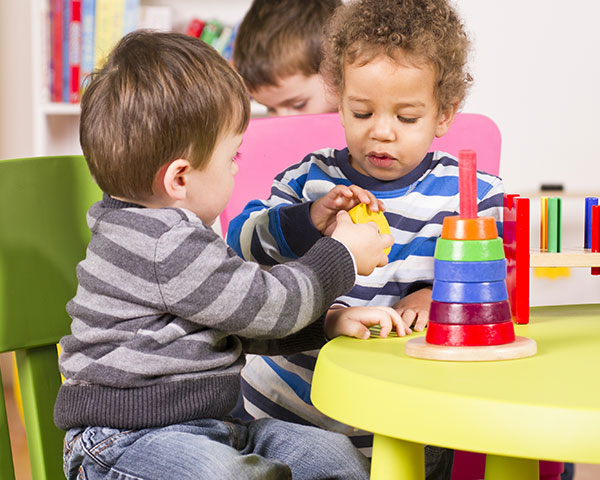
Play also gives children a voice, especially when they do not yet have the words. A child building a tower may be exploring persistence. Another pouring water repeatedly may be discovering cause and effect. A group pretending to cook may reflect their home experiences, culture, and identity.
As educators, our role is not to direct play, but to understand it—to observe closely, listen deeply, and create environments where children feel safe enough to explore, try, make mistakes, and grow.
There is also a deeper layer—play as healing. For children experiencing transitions, stress, or emotional challenges, play becomes a safe outlet. It allows them to express what they cannot explain. In diverse classrooms, including those shaped by migration or complex family experiences, play becomes a bridge between home and school, past and present.
In my own experience working with children from different cultural backgrounds, I have seen how play carries identity. Children often talk about their home experiences during play. One says, “My daddy drives a big truck.” Another shares, “My mum works in an ambulance.” These are not small moments—they are powerful expressions of belonging.
Yet, in a fast-paced world that often prioritizes early academics, play can be undervalued. Parents may ask educators to focus on writing names or teaching the alphabet. Educators may feel pressure to show visible outcomes such as letters and numbers. However, the outcomes of play are deeper and long-lasting: confidence, resilience, creativity, and emotional intelligence.
So, what does this mean for our daily practice?
It means we must protect play. We must advocate for it and help families understand that when children are playing, they are building the foundation for lifelong learning.
It also means being intentional setting up environments that invite curiosity, offering materials that reflect children’s cultures and experiences, and being present not just physically, but emotionally.
At the end of the day, when the classroom quiets and the toys are put away, what remains are small but powerful moments: a child who felt safe enough to join in, two children who learned to share, and a group who created something together.
These are the outcomes of play—and they matter.
Author Bio
Winnie Muhumuza is a Rwandan Registered Early Childhood Educator in Ontario, a Parenting Coach, and an Inclusion Advisor with over 20 years of experience in education and parenting. She holds a Master’s degree in Education from the University of Edinburgh, UK and a Diploma in Early Childhood Education from Ontario. Winnie is passionate about supporting children’s emotional well-being and helping families build strong, nurturing relationships through everyday experiences.